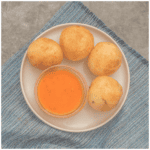
Guyanese Egg Ball
Learn how to make Guyanese egg balls using boiled and mashed cassava as the base. A seasoned dough that encases the boiled egg that is cooked to perfection. Soft and pillowy on the inside and crispy on the outside, definitely a must try!.
Servings 3 people
Calories 496kcal
Ingredients
- 6 large eggs
To boil the cassava
- 1½ lb frozen cassava
- 1 teaspoon pink salt
To make the dough
- 1 teaspoon garlic granules
- 1 teaspoon onion granules
- 1 scallion sliced
- 1 tsp pink salt
- olive oil for frying
Instructions
- Place the eggs in a medium sized saucepan with cold water.
- Bring to the boil then reduce to a simmer for 10 minutes or to your prefernce (see the notes).
- Once boiled drain off the water and immediely transfer the eggs to cold water to halt further cooking.
- Peel the eggs when they are cool then set aside.Place the cassava in a medium sized saucepan with cold water and 1 teaspoon of pink salt.
- Bring to the boil and cook for 15-20 minutes or until the cassava is fork tender and easy to crush (test the readiness with a fork). It should be really soft and the colour of the cassava should be translucent and not obaque.
- Once cooked, drain off the water.
- Immediately transfer the cassava into a medium sized bowl with a small amount of leftover hot water (equavalent to afew tablespoons).
- While the cassava is still hot, use a fork or potato masher to crush the cassava until it is smooth and lump free.
- Add the onion granules, garlic granules pink salt and then scallion (if you are using).
- Continue to mash the cassava so the add in ingredients are incorporated (make sure the scallion isn't sticking out as it will burn when frying) by now it should be firm and can hold its shape (you can form it into a dough if you want to).
- Do a taste test of the mixture and add aditional seasoning if needed.
- Coat the palm of your hand(s) with olive oil then add about ⅓ cup worth of the cassava to the centre of your hand.
- Roll the cassava into a ball then flatten it into a disc.
- Place the egg directly in the centre and bring the cassava round so it is encasing the egg.
- Gently roll to create a smooth ball with no cracks or gaps.
- Repeat the above 4 steps with the rest of the cassava.
- Heat olive oil on medium heat in a small non stick frying pan, make sure the oil is hot before proceeding with the next step.
- Once hot, add one of the egg balls, frying one side at a time, making sure to move the pan in a back and fourth and side to side motion.
- Also baste the ball with the hot oil and continue to cook until golden brown.
- Once done, place the ball on some kitchen towel and repeat the above 2 steps
Notes
- When draining off the cassava, leave alittle liquid so it makes it easier to breakdown the cassava.
- Cook the eggs to your preference. Here is a guide of how long you should cook them to your liking - Set white egg with runny yolk - 5-6 minutes, Almost set /soft eggs - 7-8 minutes and Hard boiled egg - 10 minutes.
- If you are using fresh cassava, you will need to peel and chop the cassava into small pieces.
- Make sure the oil is hot is very hot throughout the cooking process as this will make the outside crispy and not soggy and oil logged.
- The fresh and sometimes the frozen cassava has the stalk in the middle that needs to be removed
- It is very important to mash the cassava while it is hot because it will be much easier to work with.
- Make sure to use a non stick frying pan.
- Using a small frying pan means less oil is needed. A frying pan roughly the size of 20cm is ideal.
- Make sure to apply oil to your hands each time before forming the dough as this will prevent any sticking.
- Don't overcook the eggs, 10 minutes is the sweet spot for firm eggs . Keep in mind that the eggs will continue to cook when shallow frying which is why you don't want them overcooked.
- Crush the cassava by hand using a fork or potato masher, using a food processor can run the risk of the texture becoming too gummy.
- Don't overcrowd the frying pan, just cook one ball at a time.
Nutrition
Calories: 496kcal | Carbohydrates: 88g | Protein: 14g | Fat: 9g | Saturated Fat: 3g | Polyunsaturated Fat: 2g | Monounsaturated Fat: 3g | Trans Fat: 0.03g | Cholesterol: 327mg | Sodium: 1709mg | Potassium: 766mg | Fiber: 4g | Sugar: 4g | Vitamin A: 545IU | Vitamin C: 48mg | Calcium: 93mg | Iron: 2mg